The Blue Hole in Belize
A circle of darkness. A learning journey into Belize’s reef, geology and living natural heritage.
From above, the Great Blue Hole looks almost unreal: a dark circular opening surrounded by bright turquoise reef water. But the real story is stronger than fantasy. This experience turns one of Belize’s most iconic natural wonders into a structured learning journey about limestone, former cave systems, sea-level change, reef ecology and conservation.
From wonder to understanding.
This website is built as a learning experience, not only as a visual showcase. The goal is to move from the first moment of awe into clear understanding. By the end, learners can explain why the Great Blue Hole in Belize is not only a spectacular natural image, but a geological, ecological and protected natural heritage site within the wider Belize Barrier Reef region.

Not an isolated mystery object.
The Blue Hole belongs to a wider marine landscape. It sits near Lighthouse Reef Atoll and connects to the wider Belize Barrier Reef context. The dark circle is the hook. The reef system gives it meaning.

What is the Great Blue Hole?
The Great Blue Hole is a marine sinkhole off Belize. From above, it appears as a near-perfect dark circle inside the shallow reef waters of Lighthouse Reef Atoll. Its dramatic appearance has made it one of the most recognizable ocean images in the world.
A useful way to understand it is this: the Blue Hole is a visible memory of an older landscape. What we see today as a dark circular marine feature was shaped by processes that began when sea levels were much lower and parts of the limestone environment were exposed to air.
How limestone became a marine sinkhole.
This section uses the supplied Blue Hole formation visual as an educational reference, but the factual labels are controlled by the website. That keeps the image beautiful and the learning accurate: the Great Blue Hole is roughly 300 m across and more than 120 m deep — not 300 m deep.
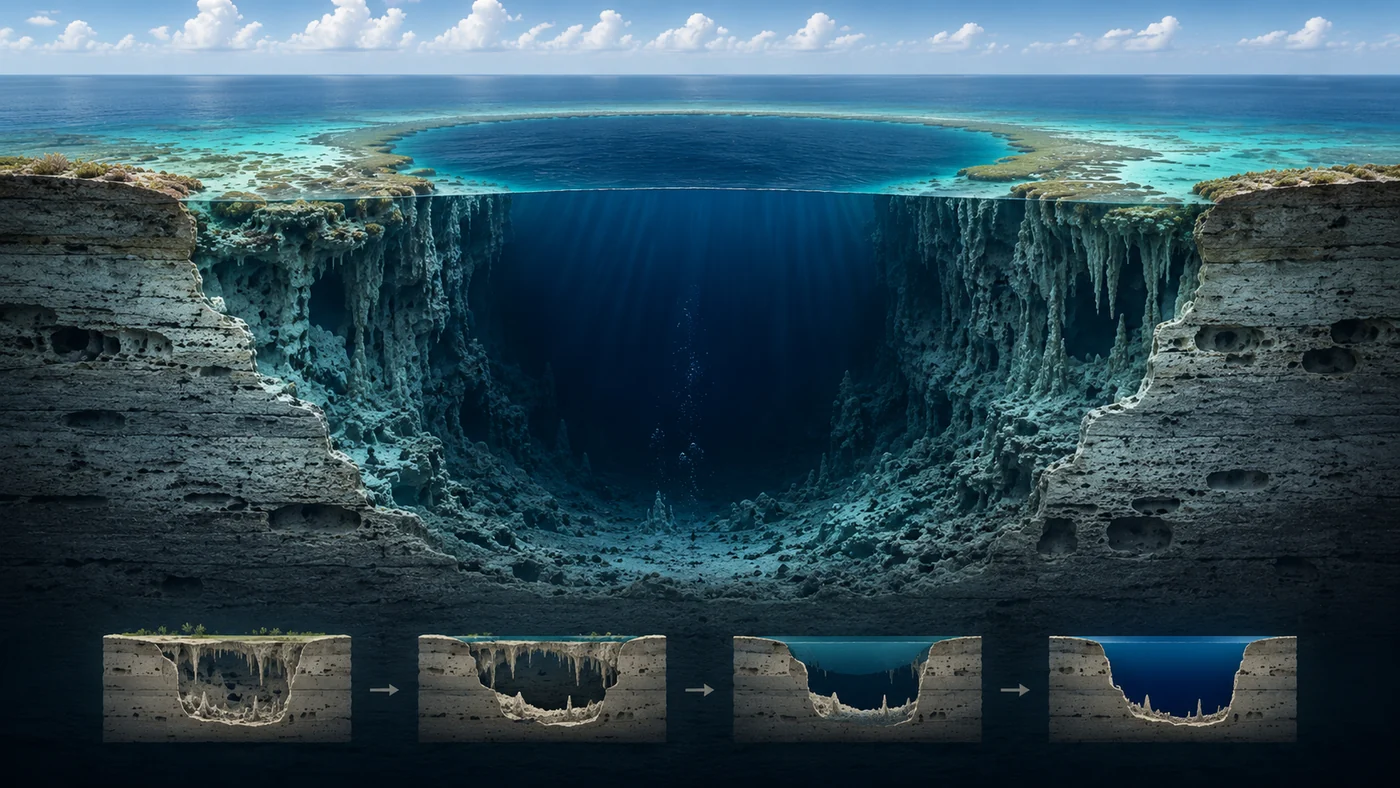 Click to enlarge
The visual is used to explain sequence and structure. Exact measurements are handled in the text and sources section so the website does not rely on misleading embedded labels.
Tap a term before you continue.
These short definitions make the rest of the learning journey easier to read.
Three spots. Three ideas.
Tap the glowing points. Each point translates the image into one learning idea: reef rim, deep center and wider reef region. The goal is not only to look at the image, but to read it.
Reef rim
The bright rim shows shallow reef water. This contrast helps the dark center become visible from above.
The circle gets attention. The reef gives it meaning.
The wider Belize reef region includes reefs, cayes, atolls, mangroves, seagrass and marine habitats. These systems support biodiversity, coastal protection, fisheries, tourism and cultural identity. When we learn about the Blue Hole, we also learn to zoom out.

Wonder without misinformation.
Myth: It is a portal.
Fact: It is a real marine sinkhole shaped by limestone, cave-forming processes and sea-level change.
Myth: It is the deep sea.
Fact: It is not the true open deep ocean. It belongs to a reef and atoll context.
Myth: Beauty needs no accuracy.
Fact: Strong visuals become stronger when facts are handled carefully.
Dive below or view from above.
The same place teaches different things depending on the perspective. Choose a path and the learning focus changes.
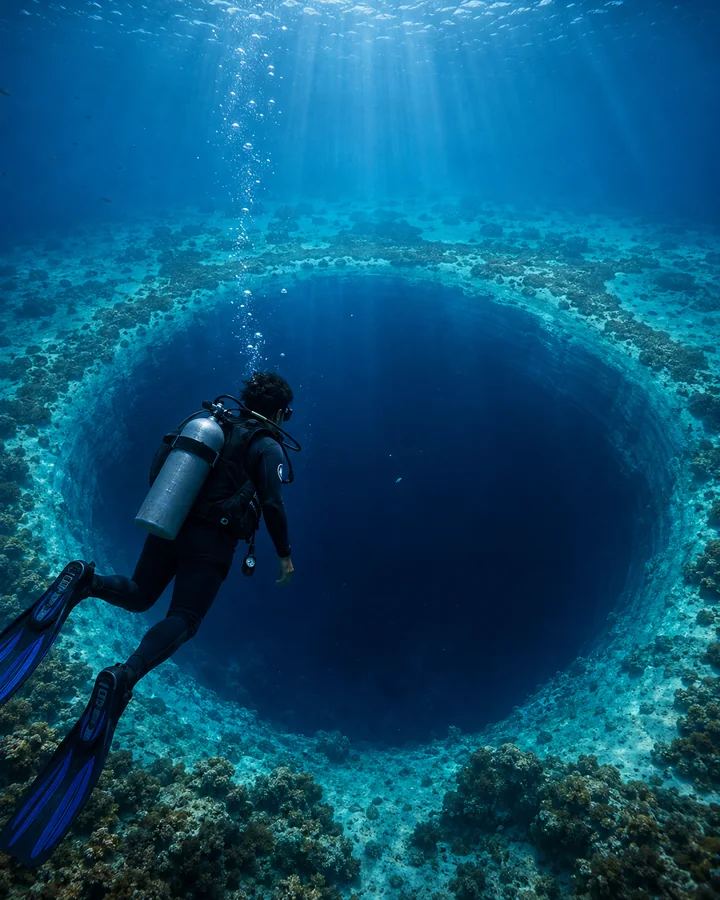
The video sequence becomes a learning bridge.
The film arc moves from surface to reef, from reef to edge, and from edge into shadow. The goal is not fantasy. The goal is to let cinematic media create attention while learning design turns that attention into understanding.
 Surface / expedition
 Diver preparation
 Reef edge
 Descent
 Limestone shadow
Tap. Reveal. Remember.
Each card compresses one idea into a reusable microlearning unit.
One question at a time.
Finish the 10-question knowledge check first.
The certificate menu appears only after the final quiz question. The Activity Sheet is a separate learning download below, not the certificate itself.
Blue Hole Explorer Certificate
Completed.
You completed the interactive knowledge check and practiced the core ideas: marine sinkhole formation, reef context, conservation and source-sensitive storytelling.
Explain it in one sentence.
Before this experience, the Blue Hole may have looked like a mysterious image. Now the goal is to explain it accurately: geology, reef context and conservation in one short sentence.
Microlearning Summary
Key idea: The Great Blue Hole is a visually iconic marine sinkhole shaped by limestone, sea-level change and reef context.
- It is a real geological formation, not a fantasy portal.
- Its dark circle comes from depth, light and contrast.
- It belongs to a wider Belize Barrier Reef context.
Keep the learning.
Download a printable recap with formation sequence, mini glossary, five recap questions and a one-sentence explanation challenge.
Download Activity Sheet PDFWatch the cinematic learning video.
The final video turns the learning journey into a compact cinematic sequence: surface, reef, edge, descent, stone and reflection. Use it after the interactive modules as a visual recap.
Take the knowledge checkVideo transcript / learning beats
- Surface: The Blue Hole catches attention as a dark circle in turquoise reef water.
- Reef edge: The visual contrast introduces depth, light and perspective.
- Descent: Limestone walls and darkness connect the image to geological memory.
- Reflection: The Blue Hole is a real marine sinkhole, not a fantasy portal.
Wonder, but fact-checked.
This page separates fact, interpretation and metaphor. The phrase ‘doorway into the living dark’ is used as a visual metaphor, not as a literal scientific claim. The Blue Hole is presented as a marine sinkhole in a reef and atoll context, not as the true open deep ocean. Measurements are treated carefully: around 300 m across and more than 120 m deep, not 300 m deep.
NASA Earth Observatory
Used for formation context, marine sinkhole framing, Lighthouse Reef location and approximate scale.
science.nasa.gov — Lighthouse Reef and the Great Blue HoleUNESCO World Heritage Centre
Used for the Belize Barrier Reef Reserve System, World Heritage and protected-area context.
whc.unesco.org — Belize Barrier Reef Reserve SystemBelize Audubon Society
Used for conservation, protected-area management and monitoring context.
belizeaudubon.orgW3C WCAG 2.2
Used for the accessibility-aware, WCAG 2.2 AA-oriented prototype direction.
w3.org/TR/WCAG22Schema.org LearningResource
Used for the structured-data concept around this interactive educational resource.
schema.org/LearningResourceGoogle Search Central
Used for SEO, structured data and social preview implementation logic.
developers.google.com/search/docsAccuracy principles used on this page
- Facts, interpretation and metaphor are separated.
- The Blue Hole is described as a marine sinkhole in a reef and atoll context, not as the true open deep ocean.
- Species and habitat information is attached to the wider reef region, not falsely placed inside the dark center.
Complete learning structure.
This is the visible learning sitemap of the current website. The ZIP package also includes a technical sitemap.xml and robots.txt for static hosting.
Built as a learning system.
H5P-ready
Cards, quiz, hotspots, branching and summary are structured so they can later become H5P-style learning objects.
LMS-ready
Each section can become a module with learning objective, introduction, visual explanation, activity, knowledge check, feedback and completion criterion.
xAPI-ready
Future events can track opened modules, selected paths, flipped cards, completed quiz, downloaded sheet and reflection.
WCAG-oriented
Semantic structure, keyboard-friendly interactions, visible focus states, text feedback, reduced-motion support and transcript-ready media areas are planned.
WCAG 2.2 AA-oriented, not a certified audit.
This website is built as an accessibility-aware learning prototype. It uses semantic sections, readable contrast, visible focus states, keyboard-friendly interactions, text feedback in the quiz, reduced-motion support and transcript-ready media areas. A full WCAG audit can be added in a later project phase.
Keyboard
Buttons, cards, quiz options and accordions are designed to remain usable without relying only on hover.
Text alternatives
Visual modules include text explanations so learning is not carried by images or color alone.
Honest scope
WCAG-oriented means accessibility-aware implementation direction, not official certification.